Holy Basil Extract
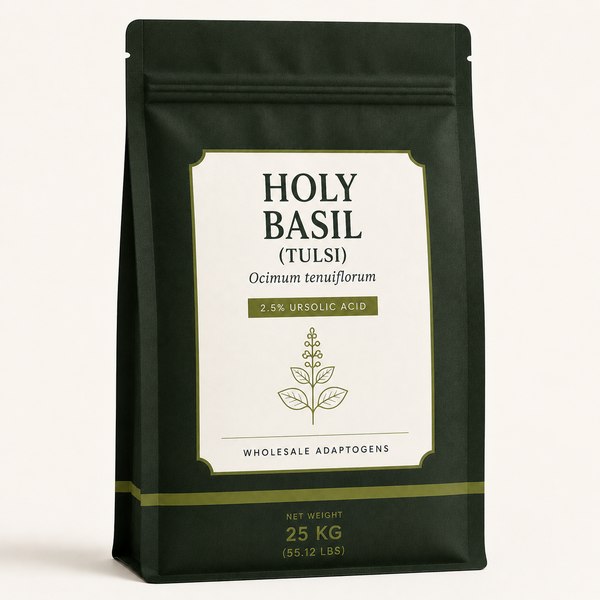
Ocimum sanctum — Tulsi leaf extract standardised for ursolic acid content, supplied for stress and immune-support formulations.
A leaf extract, not a root — and a plant with genuine cultural standing.
Unlike most of the root extracts elsewhere in our range, Holy Basil — known as Tulsi in India, where it originates — is a leaf extract, standardised to 2.5% ursolic acid. In India the plant holds genuine cultural and religious significance beyond its botanical use, traditionally grown in household courtyards and temple grounds for centuries.
Ursolic acid is the marker most consistently used to grade the trade specification. Every batch carries a certificate of analysis confirming this by HPLC. See Quality Assurance for the full testing process.
Where this extract typically gets used.
Stress & immune-support formulas
The primary use case — often formulated alongside Ashwagandha in general stress-resilience and immune-support stacks.
Tea & powder-blend formats
Tulsi has a long history as a brewed tea, giving it steady crossover demand from tea-format buyers alongside standard capsule and powder-blend formulations.
The primary use case — often formulated alongside Ashwagandha in general stress-resilience and immune-support stacks.
Tulsi has a long history as a brewed tea, giving it steady crossover demand from tea-format buyers alongside standard capsule and powder-blend formulations.
Where it comes from, and how we hold that to a standard.
Trade buyers increasingly need to answer sourcing questions themselves — here's what we can tell you about this specific ingredient.
GMP-certified processing
Grown and processed at a GMP-certified facility in India, audited on our own schedule rather than taken on trust from a spec sheet — see Quality Assurance.
Culturally rooted growing regions
Sourced from Indian growing regions with generations of dedicated Tulsi cultivation — a plant genuinely embedded in local agricultural and cultural practice, not a recent introduction.
Long-term supplier relationships
We work with established processing partners on an ongoing basis rather than opportunistic spot-buying, which supports both batch-to-batch consistency and supply continuity.
Batch traceability
Every batch is traceable back to its processing facility and harvest window — ask if you need this documented for your own supply-chain due diligence.
Grown and processed at a GMP-certified facility in India, audited on our own schedule rather than taken on trust from a spec sheet — see Quality Assurance.
Sourced from Indian growing regions with generations of dedicated Tulsi cultivation — a plant genuinely embedded in local agricultural and cultural practice, not a recent introduction.
We work with established processing partners on an ongoing basis rather than opportunistic spot-buying, which supports both batch-to-batch consistency and supply continuity.
Every batch is traceable back to its processing facility and harvest window — ask if you need this documented for your own supply-chain due diligence.
What to know before formulating with this ingredient.
General safety information for trade buyers and formulators — not medical advice, and not a substitute for your own regulatory and safety assessment. See the full Warnings & Safety Information page for the complete catalogue reference.
| Consideration | Detail |
|---|---|
| Blood glucose | May lower blood glucose — caution alongside diabetes medication. |
| Pregnancy & breastfeeding | Not recommended during pregnancy. Ensure your own finished-product labelling carries appropriate consumer-facing guidance. |
| Medication interactions | Possible interaction with anticoagulant medication. Flag clearly where relevant to your formulation. |
May lower blood glucose — caution alongside diabetes medication.
Not recommended during pregnancy. Ensure your own finished-product labelling carries appropriate consumer-facing guidance.
Possible interaction with anticoagulant medication. Flag clearly where relevant to your formulation.
Holy Basil, answered.
Leaf. Unlike most of the adaptogens in our range, which are root extracts, Holy Basil is made from the leaf of Ocimum sanctum — standardised to 2.5% ursolic acid.
Yes — Tulsi is the common name used in India, where the plant originates and holds genuine cultural and religious significance; "Holy Basil" is the English translation used more widely in Western trade and retail.
By HPLC, per batch, with the certificate of analysis showing the tested ursolic acid percentage for the specific batch you're buying.
It follows the standard Starter tier from 1–10kg/month — see Wholesale & Trade Accounts for the full tier structure.
See the Safety & Risk Information above for known considerations, particularly around blood glucose and anticoagulant medication. This isn't medical advice — consumer-facing products should carry appropriate guidance to consult a healthcare professional.
Request the COA and trade pricing for Holy Basil.
Tell us your target volume and we'll come back with pricing and the current batch certificate of analysis.