
Licorice Root Extract
Glycyrrhiza glabra — root extract supplied in two genuinely different grades, for adrenal-support and general formulation use.
Two grades, and the choice genuinely matters for safety, not just positioning.
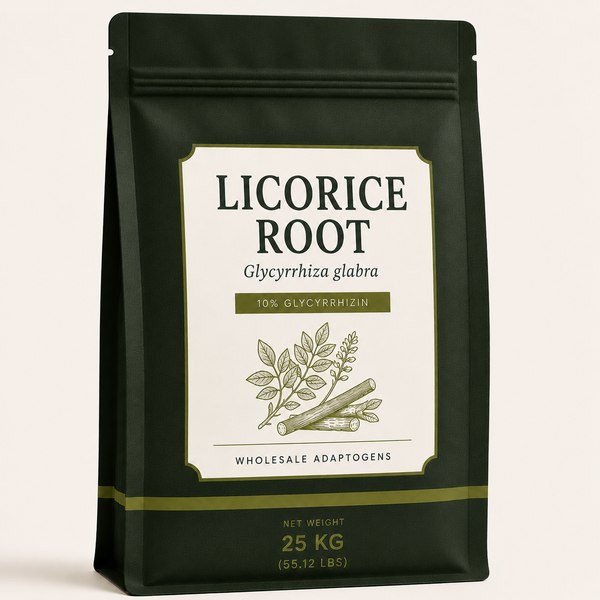
Licorice root is supplied in two meaningfully different grades. Standard extract, standardised to 20% glycyrrhizin, is the traditional adrenal-support formulation. DGL — deglycyrrhizinated licorice — has the glycyrrhizin compound specifically removed. This isn't a preference choice like some of the format decisions elsewhere in our range; the two grades genuinely differ in their safety profile, and which one is right depends on your formulation's target use and audience. See the Safety & Risk Information below before deciding.
We supply both grades — tell us which one you need when you enquire. Every batch carries a certificate of analysis confirming glycyrrhizin content (or its absence, for DGL) by HPLC. See Quality Assurance for the full testing process.
Where each grade typically gets used.
Adrenal-support formulas (standard grade)
The traditional use case for the full-glycyrrhizin standard extract — appropriate where the target consumer group doesn't fall into the contraindicated categories below.
Conservative positioning (DGL grade)
The more cautious choice — suited to general-audience formulations or where you'd rather not need to screen for hypertension, pregnancy or cardiac conditions.
The traditional use case for the full-glycyrrhizin standard extract — appropriate where the target consumer group doesn't fall into the contraindicated categories below.
The more cautious choice — suited to general-audience formulations or where you'd rather not need to screen for hypertension, pregnancy or cardiac conditions.
Where it comes from, and how we hold that to a standard.
Trade buyers increasingly need to answer sourcing questions themselves — here's what we can tell you about this specific ingredient.
GMP-certified processing
Processed at a GMP-certified facility, audited on our own schedule rather than taken on trust from a spec sheet — see Quality Assurance.
Established Mediterranean growing regions
Sourced from regions with generations of dedicated licorice cultivation, rather than opportunistic growing on land with no track record for the crop.
Long-term supplier relationships
We work with established processing partners on an ongoing basis rather than opportunistic spot-buying, which supports both batch-to-batch consistency and supply continuity.
Batch traceability
Every batch is traceable back to its processing facility and grade — ask if you need this documented for your own supply-chain due diligence.
Processed at a GMP-certified facility, audited on our own schedule rather than taken on trust from a spec sheet — see Quality Assurance.
Sourced from regions with generations of dedicated licorice cultivation, rather than opportunistic growing on land with no track record for the crop.
We work with established processing partners on an ongoing basis rather than opportunistic spot-buying, which supports both batch-to-batch consistency and supply continuity.
Every batch is traceable back to its processing facility and grade — ask if you need this documented for your own supply-chain due diligence.
Read this before choosing a grade.
This is one of the more significant safety profiles in our range, and the grade you choose genuinely affects it. General information for trade buyers and formulators — not medical advice, and not a substitute for your own regulatory and safety assessment. See the full Warnings & Safety Information page for the complete catalogue reference.
| Consideration | Detail |
|---|---|
| Blood pressure & potassium (standard grade) | Prolonged or high-dose use of glycyrrhizin-containing licorice is well documented in medical literature to raise blood pressure and deplete potassium. |
| Contraindicated conditions (standard grade) | Not recommended for hypertension, pregnancy or cardiac conditions unless DGL grade is used instead. |
| DGL grade | Deglycyrrhizinated licorice has the glycyrrhizin compound removed, avoiding the blood-pressure and potassium considerations above — the more conservative choice for general-audience formulations. |
Prolonged or high-dose use of glycyrrhizin-containing licorice is well documented in medical literature to raise blood pressure and deplete potassium.
Not recommended for hypertension, pregnancy or cardiac conditions unless DGL grade is used instead.
Deglycyrrhizinated licorice has the glycyrrhizin compound removed, avoiding the blood-pressure and potassium considerations above — the more conservative choice for general-audience formulations.
Licorice Root, answered.
It depends on your target audience and formulation. If you can't guarantee your consumer base excludes hypertension, pregnancy and cardiac conditions — which is most general-audience products — DGL is the more conservative choice. Standard grade suits more targeted adrenal-support formulations where you have better control over labelling and audience.
Glycyrrhizin, the compound licorice is best known for, affects how the body regulates sodium and potassium at sufficient dose and duration — a well-established, well-documented mechanism, not a vague or speculative caution. It's specifically why DGL exists as a separate trade grade.
By HPLC, per batch. For standard grade, the COA confirms glycyrrhizin content; for DGL, it confirms the glycyrrhizin has been removed to the expected specification.
It follows the standard Starter tier from 1–10kg/month — see Wholesale & Trade Accounts for the full tier structure, for either grade.
This is one of the more significant safety profiles in our catalogue if you're using standard grade — please read the Safety & Risk Information above in full before formulating. This isn't medical advice; consumer-facing products should carry clear guidance to consult a healthcare professional, and DGL grade is worth strong consideration for general-audience products.
Request the COA and trade pricing for Licorice Root.
Tell us your target volume and which grade — standard or DGL — and we'll come back with pricing and the current batch certificate of analysis.