
Suma Root Extract
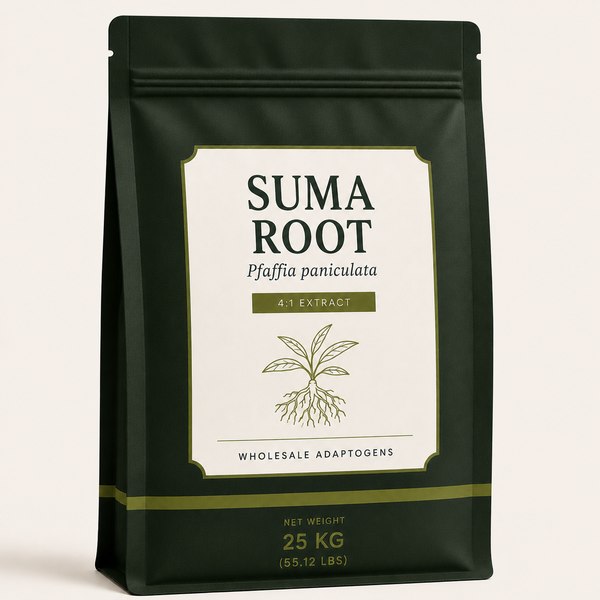
Pfaffia paniculata — often called "Brazilian Ginseng," a root extract native to the Amazon and Cerrado regions, supplied for general vitality formulations.
Honestly positioned — a smaller, steady line rather than an evidence powerhouse.
Suma root, often marketed as "Brazilian Ginseng," isn't actually a ginseng species — it's Pfaffia paniculata, native to the Amazon and Cerrado regions of Brazil, from a completely different plant family. Unlike Panax ginseng, Suma doesn't have a single universally agreed trade standardisation marker; ask us for the current batch's specific testing detail if you need a particular specification documented.
It has a smaller, more recent commercial history in Western markets than most of the other adaptogens in our range, with correspondingly less modern research behind it — worth knowing honestly rather than overstating. Every batch still carries a certificate of analysis. See Quality Assurance for the full testing process.
Where this extract typically gets used.
General vitality formulas
Niche but steady demand for general vitality positioning — a smaller-volume line compared to the more established adaptogens in our range.
Complementary blend ingredient
More often formulated as one component within a broader adaptogen blend than sold as a standalone SKU — ask about blend formulation support.
Niche but steady demand for general vitality positioning — a smaller-volume line compared to the more established adaptogens in our range.
More often formulated as one component within a broader adaptogen blend than sold as a standalone SKU — ask about blend formulation support.
Where it comes from, and how we hold that to a standard.
Trade buyers increasingly need to answer sourcing questions themselves — here's what we can tell you about this specific ingredient.
GMP-certified processing
Processed at a GMP-certified facility, audited on our own schedule rather than taken on trust from a spec sheet — see Quality Assurance.
Amazon & Cerrado sourcing
Sourced from Brazil's Amazon and Cerrado regions — areas where responsible sourcing matters more than most, given the well-known environmental sensitivity of the wider region.
Long-term supplier relationships
We work with established processing partners on an ongoing basis rather than opportunistic spot-buying, which supports both batch-to-batch consistency and supply continuity.
Batch traceability
Every batch is traceable back to its processing facility and origin — ask if you need this documented for your own supply-chain due diligence.
Processed at a GMP-certified facility, audited on our own schedule rather than taken on trust from a spec sheet — see Quality Assurance.
Sourced from Brazil's Amazon and Cerrado regions — areas where responsible sourcing matters more than most, given the well-known environmental sensitivity of the wider region.
We work with established processing partners on an ongoing basis rather than opportunistic spot-buying, which supports both batch-to-batch consistency and supply continuity.
Every batch is traceable back to its processing facility and origin — ask if you need this documented for your own supply-chain due diligence.
What to know before formulating with this ingredient.
General safety information for trade buyers and formulators — not medical advice, and not a substitute for your own regulatory and safety assessment. See the full Warnings & Safety Information page for the complete catalogue reference.
| Consideration | Detail |
|---|---|
| Limited research base | Limited modern safety data available relative to other adaptogens in our range — general caution advised pending further research. |
| Pregnancy & breastfeeding | Given the limited safety data available, not recommended during pregnancy or breastfeeding as a precaution. |
Limited modern safety data available relative to other adaptogens in our range — general caution advised pending further research.
Given the limited safety data available, not recommended during pregnancy or breastfeeding as a precaution.
Suma Root, answered.
No — "Brazilian Ginseng" is a marketing name. Suma is Pfaffia paniculata, from a different plant family entirely, unrelated to true Panax ginseng.
Suma is a smaller-volume ingredient without the same universally agreed trade standardisation convention that more established adaptogens like Ashwagandha or Panax ginseng have. Ask us for the current batch's specific testing detail if you need a documented marker for your formulation.
It means there simply isn't the same volume of modern clinical research behind Suma that exists for more established adaptogens — not that it's known to be riskier, just less studied. We'd rather be upfront about that than overstate the evidence base.
It follows the standard Starter tier from 1–10kg/month — see Wholesale & Trade Accounts for the full tier structure.
Given the limited research base, we'd recommend a more conservative approach to formulation and labelling than for better-studied ingredients — see the Safety & Risk Information above. This isn't medical advice.
Request the COA and trade pricing for Suma Root.
Tell us your target volume and we'll come back with pricing and the current batch certificate of analysis.