
Turkey Tail Extract
Trametes versicolor — fan-shaped fruiting-body mushroom with the deepest research history in our range, standardised for polysaccharide content.
Named for its looks, known for its research history.
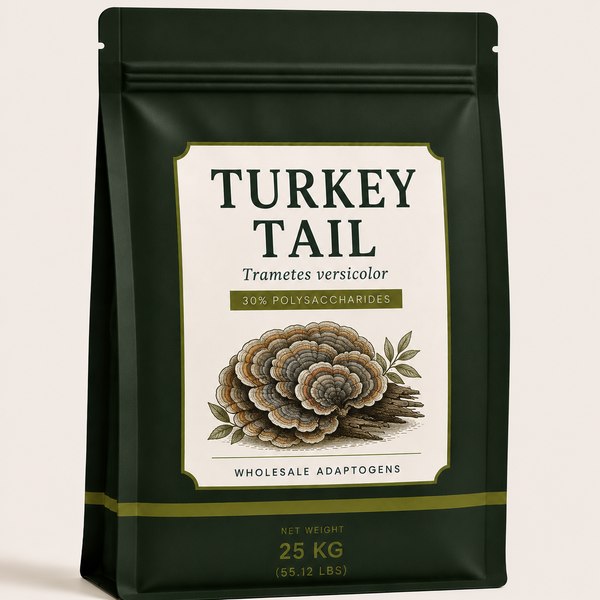
Turkey Tail gets its name from its genuinely distinctive appearance — fan-shaped, with concentric coloured rings resembling a wild turkey's tail feathers, one of the most visually recognisable mushrooms we supply. It also carries the most substantial documented research history of any mushroom in our range: its polysaccharide compounds, PSK and PSP, are among the most extensively studied mushroom-derived compounds globally, with a research history that includes formal regulatory use in Japan.
We supply standardised to 20–30% polysaccharides, the highest standardisation range of any mushroom in our catalogue. Every batch carries a certificate of analysis confirming this by HPLC. See Quality Assurance for the full testing process.
Where this extract typically gets used.
Immune-support formulas
The primary use case — commonly formulated alongside Reishi or Astragalus in general immune-resilience stacks.
Research-forward positioning
Its documented research depth is genuine and worth leading with for buyers wanting an evidence-based formulation story rather than a purely traditional one.
The primary use case — commonly formulated alongside Reishi or Astragalus in general immune-resilience stacks.
Its documented research depth is genuine and worth leading with for buyers wanting an evidence-based formulation story rather than a purely traditional one.
Where it comes from, and how we hold that to a standard.
Trade buyers increasingly need to answer sourcing questions themselves — here's what we can tell you about this specific ingredient.
GMP-certified processing
Grown and processed at a GMP-certified facility in China, audited on our own schedule rather than taken on trust from a spec sheet — see Quality Assurance.
Fruiting-body verified
Every batch is verified as fruiting-body material, not the cheaper mycelium-on-grain biomass sometimes used to bulk out lower-grade Turkey Tail products.
Long-term supplier relationships
We work with established processing partners on an ongoing basis rather than opportunistic spot-buying, which supports both batch-to-batch consistency and supply continuity.
Batch traceability
Every batch is traceable back to its processing facility and production run — ask if you need this documented for your own supply-chain due diligence.
Grown and processed at a GMP-certified facility in China, audited on our own schedule rather than taken on trust from a spec sheet — see Quality Assurance.
Every batch is verified as fruiting-body material, not the cheaper mycelium-on-grain biomass sometimes used to bulk out lower-grade Turkey Tail products.
We work with established processing partners on an ongoing basis rather than opportunistic spot-buying, which supports both batch-to-batch consistency and supply continuity.
Every batch is traceable back to its processing facility and production run — ask if you need this documented for your own supply-chain due diligence.
What to know before formulating with this ingredient.
General safety information for trade buyers and formulators — not medical advice, and not a substitute for your own regulatory and safety assessment. See the full Warnings & Safety Information page for the complete catalogue reference.
| Consideration | Detail |
|---|---|
| General tolerability | Generally well tolerated — no significant common interactions identified. |
| Gastrointestinal effects | Mild gastrointestinal effects reported occasionally at high doses. |
Generally well tolerated — no significant common interactions identified.
Mild gastrointestinal effects reported occasionally at high doses.
Turkey Tail, answered.
Turkey Tail grows as thin, fan-shaped, concentrically-ringed fruiting bodies that overlap in clusters — visually distinct from Reishi's solid fan or Lion's Mane's cascading spines. The name comes directly from its resemblance to a wild turkey's tail feathers.
Its polysaccharide compounds, PSK and PSP, are among the most researched mushroom-derived compounds in the world, with a documented history that includes formal regulatory use in Japan. This is genuine historical and research context — not a claim about what our raw ingredient itself does, and not medical advice.
By HPLC, per batch, with the certificate of analysis showing the tested polysaccharide percentage for the specific batch you're buying.
It follows the standard Starter tier from 1–10kg/month — see Wholesale & Trade Accounts for the full tier structure.
It's generally well tolerated with no significant common interactions identified — see the Safety & Risk Information above for the minor considerations that do apply. This isn't medical advice; consumer-facing products should still carry appropriate guidance.
Request the COA and trade pricing for Turkey Tail.
Tell us your target volume and we'll come back with pricing and the current batch certificate of analysis.