
Chaga Extract
Inonotus obliquus — a birch-tree fungal growth, standardised for polysaccharide content, supplied for antioxidant and functional-coffee formulations.
Doesn't look like a mushroom, because it isn't shaped like one.
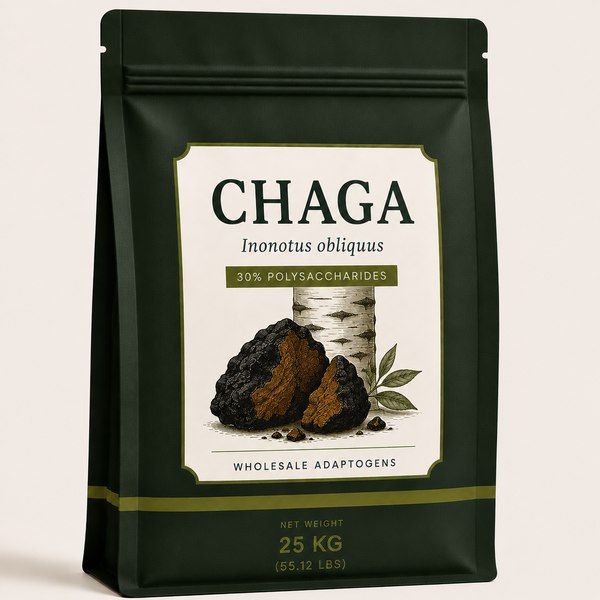
Chaga looks nothing like Reishi or Lion's Mane — it's a hard, charcoal-black growth (technically a sclerotium) found specifically on birch trees, not a conventional cap-and-stem mushroom. Its dark colour and naturally earthy character make it a particularly common ingredient in functional-coffee blends, arguably more so than any other mushroom in our range.
Unlike most other mushrooms in our catalogue, Chaga can't yet be commercially cultivated at meaningful scale, so supply is still predominantly wild-harvested from birch forests — worth knowing honestly. See Sourcing & Ethics below for how we approach the resulting sustainability considerations. We supply standardised to 10–20% polysaccharides. Every batch carries a certificate of analysis confirming this by HPLC. See Quality Assurance for the full testing process.
Where this extract typically gets used.
Functional coffee & antioxidant formulas
The primary use case — its natural dark colour and earthy character blend more seamlessly into coffee formats than most other mushrooms.
Sensory-compatible formulation
Worth factoring the natural colour and flavour profile into your formulation from the start — less need to mask it compared to more neutral or bitter mushroom powders.
The primary use case — its natural dark colour and earthy character blend more seamlessly into coffee formats than most other mushrooms.
Worth factoring the natural colour and flavour profile into your formulation from the start — less need to mask it compared to more neutral or bitter mushroom powders.
Where it comes from, and how we hold that to a standard.
Trade buyers increasingly need to answer sourcing questions themselves — here's what we can tell you about this specific ingredient.
GMP-certified processing
Processed at a GMP-certified facility, audited on our own schedule rather than taken on trust from a spec sheet — see Quality Assurance.
Responsible wild-harvest practice
Since Chaga can't yet be commercially cultivated at scale, sourcing is inherently wild-harvest — we prioritise suppliers who harvest rotationally and preserve the growing portion of the sclerotium, rather than stripping birch stands entirely.
Long-term supplier relationships
Responsible wild-harvest practice depends on consistent, accountable partners — we work with established suppliers on an ongoing basis rather than opportunistic spot-buying.
Batch traceability
Every batch is traceable back to its processing facility and harvest region — ask if you need this documented for your own supply-chain due diligence.
Processed at a GMP-certified facility, audited on our own schedule rather than taken on trust from a spec sheet — see Quality Assurance.
Since Chaga can't yet be commercially cultivated at scale, sourcing is inherently wild-harvest — we prioritise suppliers who harvest rotationally and preserve the growing portion of the sclerotium, rather than stripping birch stands entirely.
Responsible wild-harvest practice depends on consistent, accountable partners — we work with established suppliers on an ongoing basis rather than opportunistic spot-buying.
Every batch is traceable back to its processing facility and harvest region — ask if you need this documented for your own supply-chain due diligence.
What to know before formulating with this ingredient.
General safety information for trade buyers and formulators — not medical advice, and not a substitute for your own regulatory and safety assessment. See the full Warnings & Safety Information page for the complete catalogue reference.
| Consideration | Detail |
|---|---|
| Oxalate content | Chaga naturally contains oxalates — caution for those prone to kidney stones. |
| Immune-modulating effects | May not be appropriate for autoimmune conditions or alongside immunosuppressant medication. |
Chaga naturally contains oxalates — caution for those prone to kidney stones.
May not be appropriate for autoimmune conditions or alongside immunosuppressant medication.
Chaga, answered.
Because it isn't shaped like one — Chaga is technically a sclerotium, a hard mass of fungal tissue that grows on the outside of birch trees, quite different from the cap-and-stem fruiting bodies of Reishi or Lion's Mane.
Yes, honestly — Chaga can't yet be commercially cultivated at meaningful scale, unlike most other mushrooms in our range, so supply remains predominantly wild-harvested. We prioritise suppliers who harvest rotationally and leave the growing portion of the sclerotium intact, rather than stripping it entirely and killing the host tree's ability to regrow it.
Chaga naturally contains a meaningful level of oxalates, which is genuinely relevant for anyone prone to kidney stones specifically — a consideration this ingredient carries that most other mushrooms in our range don't.
It follows the standard Starter tier from 1–10kg/month — see Wholesale & Trade Accounts for the full tier structure.
See the Safety & Risk Information above, particularly around kidney stone risk and immune-modulating effects. This isn't medical advice; consumer-facing products should carry appropriate guidance.
Request the COA and trade pricing for Chaga.
Tell us your target volume and we'll come back with pricing and the current batch certificate of analysis.